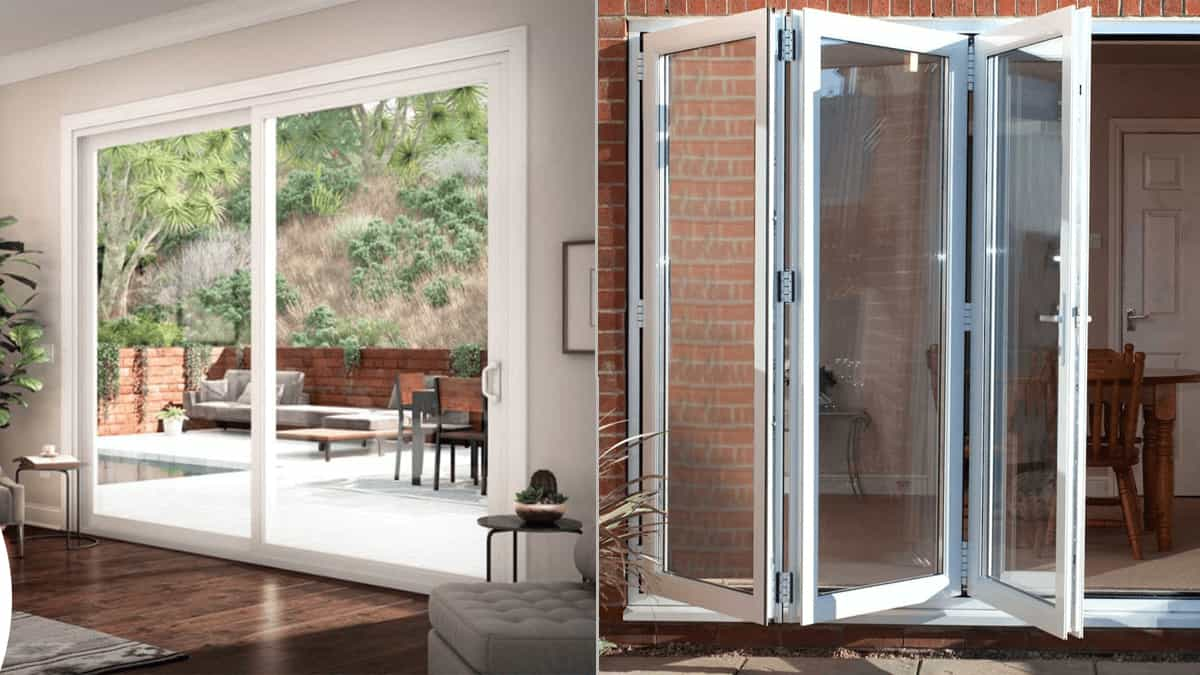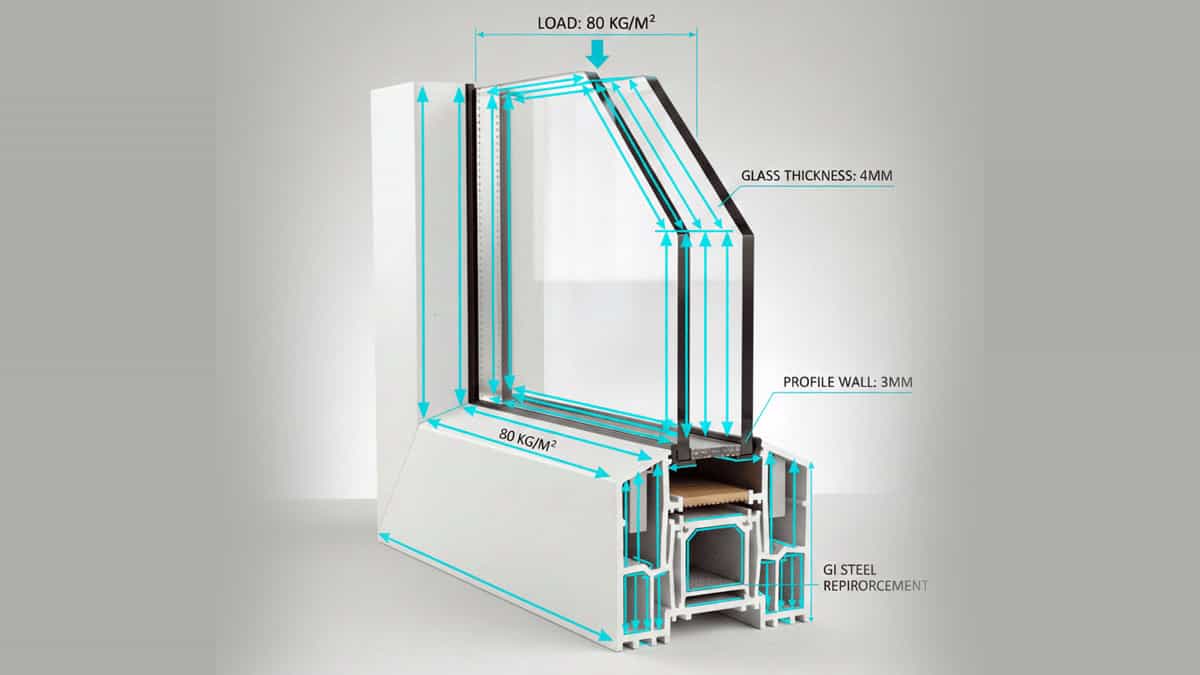
When you’re standing in a factory looking at a 3-meter wide triple-glazed sliding door, your brain sends a clear signal: That is incredibly heavy. You imagine the uPVC frame groaning under the pressure and the rollers grinding to a halt.
In the fenestration industry, “weight” is often used as a shorthand for “quality” or “difficulty.” However, if you look at the engineering data, glass is rarely as heavy as our intuition suggests. The problem isn’t usually the mass of the glass itself; it is a failure to understand how that mass is distributed through the frame.
This guide breaks down the actual physics of glass loads and explains why your uPVC frames are more capable than you realize—provided you know the math.
The Golden Rule of Glass Weight
To understand glass load, you don’t need a complex physics degree. You just need one constant. Standard float glass has a density of approximately 2,500kg/m³.
To make this practical for a workshop floor, use this “Rule of Thumb“:
Glass weighs 2.5kg per square meter ($m^2$) for every 1mm of thickness.
The Quick Math:
If you have a standard double-glazed unit (DGU) consisting of two 4mm panes ($4mm + 4mm = 8mm$ of total glass):
- $8mm \times 2.5kg = 20kg$ per $m^2$.
- A large patio door leaf ($1m \times 2.1m$) would therefore weigh roughly 42kg.
Even a heavy-duty triple-glazed unit ($4mm + 4mm + 4mm$) only comes in at 30kg per $m^2$. While that’s not “light,” compare it to a single leaf of a solid oak door or a section of stone cladding, and you’ll realize glass is a remarkably efficient building material.
Static Load vs. Dynamic Load: Where the Myth Begins
The reason glass “feels” heavier than 42kg is the difference between Static and Dynamic loads.
- Static Load: This is the weight of the glass sitting still in a fixed frame. The uPVC profile and the steel reinforcement (as discussed in our previous guide) handle this easily by transferring the force straight down to the sill.
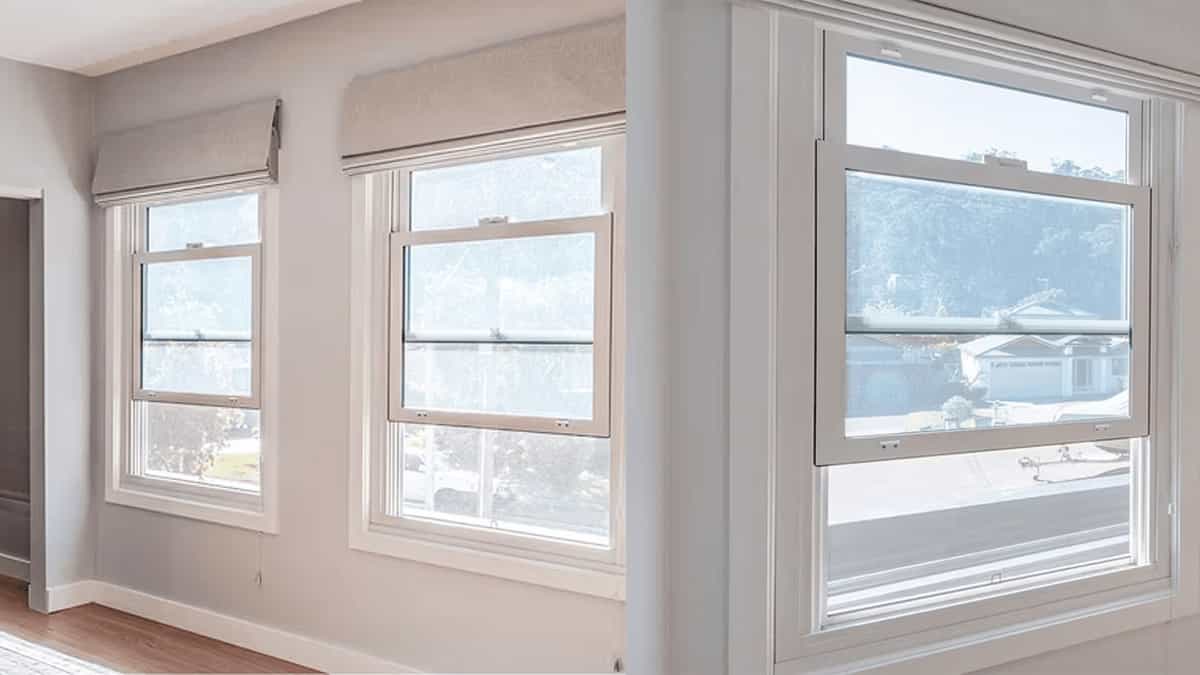
- Dynamic Load: This is where the trouble starts. When you open a casement window or a door, the glass becomes a cantilever. The weight is no longer just pushing down; it is pulling sideways on the top hinge.
If a door “drops” or scrapes, installers often blame the “heavy glass.” In reality, the glass hasn’t gotten heavier; the frame has simply failed to manage the torque (the turning force).
The “Invisible Weight” of Wind Load
If your glass isn’t as heavy as you think, why do we see frames bowing? The answer is often Wind Load.
In a high-wind zone, a glass pane acts like a sail. A gust of wind can exert a pressure of $1,000$ Pascals or more. On a standard $2m^2$ window, that wind is effectively “adding” an extra 200kg of force against the glass for the duration of the gust.
This is the “invisible weight.” When calculating if a uPVC frame can handle a specific glass unit, you aren’t just calculating for gravity; you are calculating for the moment that gravity and wind work together to try and push the glass through the frame.
Toe and Heeling: The Secret to Weight Management
The most common “weight-related” failure in uPVC isn’t a snapped frame; it’s a sagging sash. This is almost always caused by poor glass packing (Toe and Heeling).
Because uPVC is not a structural material on its own, it relies on the glass to keep the sash square. By placing plastic packers at opposite corners (the bottom hinge side and the top handle side), you use the stiffness of the glass to support the frame.
Pro Tip: If you don’t toe-and-heel correctly, the sash will deform under its own weight within weeks. This isn’t because the glass was too heavy; it’s because you didn’t allow the glass to act as the structural brace it was designed to be.
When Does Glass Actually Become “Too Heavy”?
There is a ceiling where weight becomes a genuine engineering concern for uPVC. This usually happens at two points:
- The Hardware Limit: Most standard uPVC friction stays (hinges) are rated for 24kg to 40kg. If your triple-glazed sash exceeds this, the metal hinges will deform, not the uPVC.
- The Roller Limit: For sliding doors, the rollers are the weak point. Standard tandem rollers might be rated for 80kg, while premium ones can handle 200kg+.
Final Verdict: It’s Not the Mass, It’s the Math
The next time a customer or a contractor worries that a certain glass spec is “too heavy” for uPVC, remember the 2.5kg rule.
In 90% of cases, the uPVC profile—when properly reinforced with galvanized steel—can handle the weight easily. The failures we attribute to “heavy glass” are almost always actually failures in hardware selection, wind-load calculation, or installation packing.
Respect the glass, but don’t fear it. It’s the most stable part of your window.